









U.S.D.A. Proposes New U.S.-Canada Border Fees
Washington, D.C.
By ANUK Staff
5.6.13
The U.S. Department of Agriculture has recommended new U.S. – Canada border fees, causing Canadian manufacturers and carriers - trucking and shipping companies, airlines and railways - to face the possibility of higher costs.
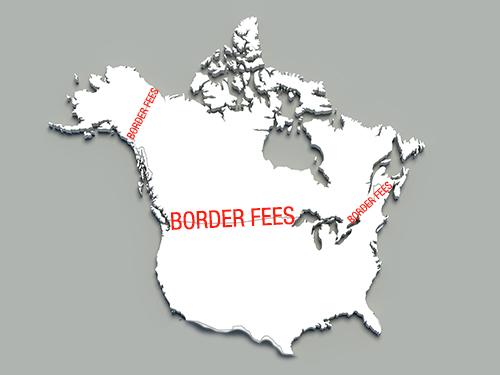
The department suggested revenue-generating border fees because some federal agencies like U.S. Customs and Border Protection are currently providing free services at the America’s borders. The organization works with agriculture quarantine and inspection program, which provides checks of imported agricultural goods and commercial aircraft, rail cars, ships and even passenger baggage to prevent harmful pests, diseases and materials from entering the U.S.
The U.S.D.A. stated that roughly $191 million in CPB costs are incurred with services for which no fees are being charged.
U.S. federal agencies “need to recover all costs associated with fee services and have fee revenue from each fee service cover the associated costs.
“Consider establishing new fees,” it concluded.
Ed Fast, Canada’s international trade minister, called the prospect of new border fees from the USDA “another protectionist measure” — and one his government would vigorously oppose. “We don’t know exactly what it’s going to look like, but certainly we’ll be contacting my counterpart in the United States to press upon them that this is not helpful at all,” Fast told reporters on Parliament Hill, as reported by the Metro News.
“If they want to drive economic growth in the U.S. — we want to do so in Canada — it’s not going to happen by raising new barriers at the border. It’s going to be by opening up trade, freeing up trade, so that we can drive prosperity in both of our countries.”
The bill also faces opposition in Congress. “I’m telling you it’s not going to happen,” Democratic lawmaker Brian Higgins said over the weekend, adding his colleague in the U.S. Senate, Chuck Schumer, is onside.
“The early indications are that both Democrats and Republicans oppose it and any new fee would have to get by both the House of Representatives, of which I am a member, and also the United States Senate, which Sen. Schumer is a member. I’m going to fight this very, very aggressively and I have a lot of allies.”
But the fees may not need Congressional approval, according toBirgit Matthiesen, the D.C.-based point person for the Canadian Manufacturers and Exporters organization.
“The border crossing fee would need authority from Congress because Homeland Security is actually proposing lifting exemptions that currently cover passengers and pedestrations,” she said.“But there is no talk of lifting exemptions with the USDA proposals, according to the initial information we’re getting.”
That means they’d be easier to establish.
On both sides of the border, trade officials point to so-called sequestration measures as the sudden villain in Canada-U.S. relations.
The cuts, aimed at slashing the mammoth $16.8 trillion U.S. national debt, have left federal departments strapped for cash and resources and looking for ways to raise revenues.
In the near future, the USDA will submit its proposals to the Office of Management and Budget, and then to move forward with formal recommendations in the coming weeks.