

IBM Supercomputer Creates Culinary Masterpieces at South By Southwest Conference

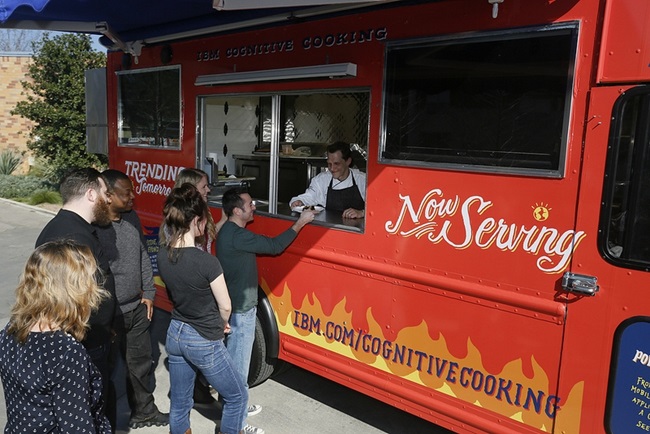
At the South by Southwest Conference (SXSW), IBM's supercomputer called Watson showed off its creative side by teaming up with the Institute of Culinary Education in New York, to create unique culinary dishes which were exhibited using a food truck. So far, Watson has already invented a Swiss-Thai asparagus quiche, an Austrian chocolate burrito, and a pork belly moussaka, according to TIME. At SXSW, the annual music, film, and interactive conference and festival held in Austin, TX, IBM researchers exhibited what they call "creative computing." The supercomputer known as Watson first appeared on the game show Jeopardy!, where it trounced champions Ken Jennings and Ben Rutter. Now Watson has a new job on its own food truck. The supercomputer uses complex algorithms in order to come up with creative meals.
"The system begins by capturing and analyzing tens of thousands of ingredient pairings and dish composition, which it rearranges and redesigns into new recipes. It then cross references these with data on the flavor compounds found in ingredients, and the psychology of people's likes and dislikes...to model how the human palate might respond to different combinations of flavors," according to a statement on IBM's company website.
Since appearing on Jeopardy! in 2008, Watson has only produced $100 million for IBM. In the beginning of 2014, IBM announced that it would invest $1 billion into its Watson Group. This includes $100 million in venture capital to fund start-ups and businesses which will build "a new class of applications powered by Watson," according to TIME.
Just as robotics and industrial machinery threaten to replace manual laborers, supercomputers could eventually take over executive and creative roles.
Though hopefully the produce industry will still prefer to read news articles written by human beings!