




Researchers Investigate Onion Compounds
Wako, Japan
By ANUK Staff
5.6.13
Researchers from the RIKEN Plant Science Center have profiled the sulfur-containing compounds in onion extracts in an attempt to identify beneficial plant compounds. Kazuki Saito, Ryo Nakabayashi and colleagues developed a technique to rapidly catalog subsets of compounds in plant extracts based on mass spectrometry data as a first step toward a fully automated system for cataloging novel plant compounds.
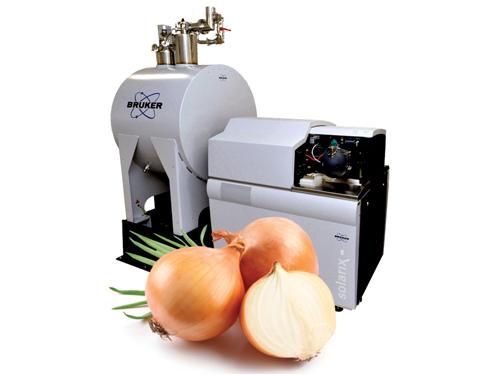
Saito and his team profiled sulfur-containing compounds in onion extracts. The compounds produce a pair of peaks in the mass spectrum — one 20 times stronger than the other — associated with the ratio of the two most common naturally occurring isotopes of the sulfur atom. Saito and his colleagues were able to identify 67 sulfur-containing ions in the onion extract. Then, using isotope chemistry, they were able to establish the number of carbon atoms in each structure.
The researchers analyzed extracts from two sets of onions: one grown under a normal atmosphere, and another grown under an atmosphere in which the carbon in CO2 was replaced with the heavier carbon isotope, carbon-13.
Mass spectrometry is a powerful tool for identifying unknown compounds, as those which contain certain heteroatoms such as oxygen, nitrogen and sulfur produce a spectral fingerprint. Saito and his team hypothesized that this characteristic could be exploited to quickly catalog compounds in plant extracts.
By measuring how much heavier a plant compound was when formed from carbon-13, the researchers could calculate its carbon count and so determine its complete atomic make-up. In a final step, the team established the full chemical structure of some of the sulfur-containing compounds by comparing their data with that of known compounds.
“We are now planning to develop an automated structural assignment system,” says Nakabayashi. The researchers hope to automate this time-consuming process by incorporating an additional analysis technique called nuclear magnetic resonance (NMR), developing a database of high-quality mass spectrometry and NMR reference data, and establishing a computational algorithm for checking each compound against this database to establish its chemical structure.
Onion Report